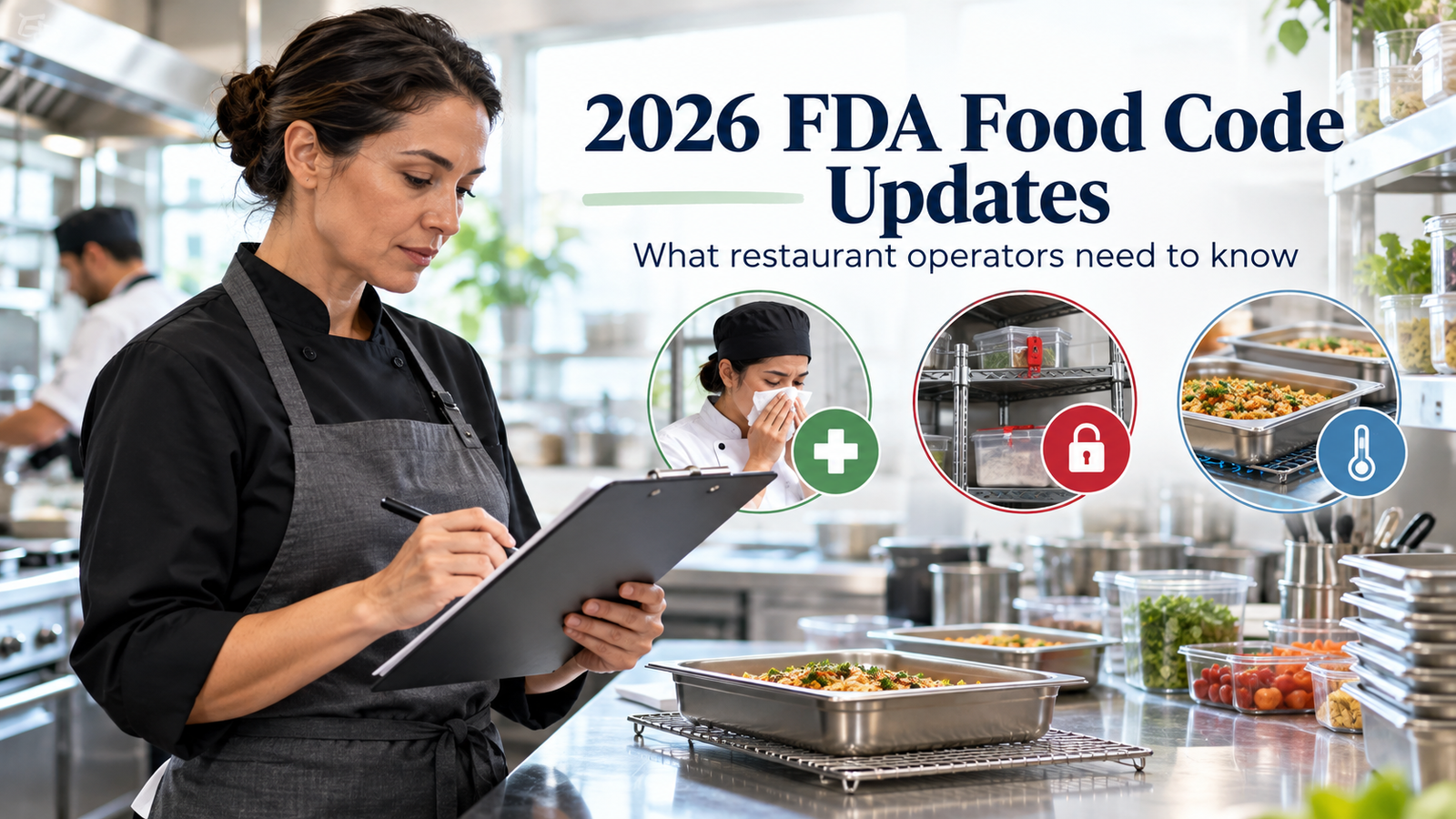
On September 17, 2026, the FDA released the latest Food Code, bringing a new round of updates that restaurant operators, food managers and training teams need to know.
The FDA Food Code is a model used by state and local regulatory agencies when developing or updating their own food safety rules. That means the new requirements do not automatically become law everywhere on September 17. States and local jurisdictions decide whether and when to adopt them. U.S. Food and Drug Administration
Still, the 2026 changes give restaurant operators a good look at where food safety requirements are headed.
Here’s the breakdown.
Written Employee Illness Policies Required
Food safety managers already know that sick food handlers can create a serious food safety risk. Traditionally, the Food Code has required certain employee illnesses and symptoms to be reported and has explained when food handlers must be restricted from certain duties or excluded from the food establishment.
Train 321’s Food Handler training and Food Manager Study Session go into depth about these requirements.
The 2026 Food Code now takes this a step further by requiring a written employee illness policy that is maintained and available.
In other words, it may no longer be enough for managers to simply know what to do when an employee is sick. The restaurant may also need to have those procedures documented in writing.
If your state or local jurisdiction adopts this portion of the 2026 Food Code, health inspectors may begin asking to see your written employee illness policy during inspections.
For restaurant operators, this is a good time to review your current procedures and make sure employees understand what symptoms and illnesses they are required to report, who they should report them to and when they may need to be restricted or excluded from work.
Food Code Reference: Section 2-501.11, Employee Illness Policy Documentation. U.S. Food and Drug Administration
Food Defense Training Added
The 2026 FDA Food Code introduces two new food-defense-related responsibilities for the restaurant manager, or person in charge.
Food defense means protecting food from intentional contamination or tampering. Food safety usually focuses on accidental contamination. Food defense focuses on deliberate acts that could make food unsafe. The 2026 Food Code formally adds “food defense” as a defined term. U.S. Food and Drug Administration
Under the new requirements, managers have two key responsibilities:
First, managers must be able to demonstrate knowledge of food defense during an inspection. This includes explaining the steps the restaurant takes to prevent intentional adulteration or tampering and how the operation monitors for unusual or suspicious activity.
Second, managers must make sure employees are aware of food defense as it relates to their jobs. Employees should understand how to recognize signs of intentional tampering or other suspicious activity and know that they should report concerns to the person in charge. U.S. Food and Drug Administration
For most restaurants, the practical answer is fairly simple: food defense awareness should become part of your food safety training.
Employees do not need to become security experts. They do need to understand what food defense means, recognize when something does not look right and know who to tell.
Train 321 can help restaurants incorporate food defense awareness into their employee training programs.
Food Code References: Sections 2-102.11(C)(18) and 2-103.11(R). U.S. Food and Drug Administration
New Cooling Options Added
Restaurants have long been required to cool time/temperature control for safety, or TCS, foods quickly enough to prevent harmful bacteria from growing.
TCS foods are foods that require time and temperature controls to remain safe. Examples include cooked meat and poultry, dairy products, cooked rice, cooked vegetables and many prepared foods.
The basic cooling time requirements have not changed. Cooked TCS food must still cool from 135°F to 70°F within two hours and then from 70°F to 41°F or below within a total of six hours. U.S. Food and Drug Administration
What has changed is the list of recognized cooling methods.
The 2026 Food Code now specifically allows food to be placed at a depth of no more than two inches as a cooling method. In practical terms, that means the food itself should be no more than two inches deep in the container. Think of spreading a batch of cooked food into a shallow layer rather than leaving it in one deep container. That matters because a deep container of hot soup, rice, beans or sauce can hold heat in the center for a long time. A shallower layer allows heat to escape much more quickly.
The Food Code still recognizes other familiar cooling methods, including:
- Using shallow pans
- Dividing food into smaller or thinner portions
- Using rapid-cooling equipment
- Placing a container in an ice-water bath and stirring the food
- Using containers that transfer heat efficiently
- Adding ice as an ingredient
- Using another effective cooling method
The important point is that the food still has to reach the required temperatures within the required time.
The 2026 Food Code also creates an alternative cooling process that may be used with regulatory approval. Under that method, cooked TCS food may be placed no more than two inches deep, held uncovered and cooled in refrigeration that meets additional monitoring requirements. U.S. Food and Drug Administration
For restaurant managers, this is a good reminder to look at how food is actually being cooled in your kitchen. Cooling procedures should be clearly understood by the people preparing and storing food, especially when your operation prepares large batches.
Food Code Reference: Section 3-501.15, Cooling Methods. U.S. Food and Drug Administration
Double Gloving Gets a New Exception
The 2026 Food Code also adds a new exception involving the use of two single-use gloves during food preparation.
Traditionally, a single-use glove is used for one task and then discarded when the employee changes tasks or when the glove becomes contaminated.
Under the new provision, an approved double-glove system may be used in certain circumstances. A food employee may wear a loose-fitting outer glove over an interior single-use glove. The outer glove can then be removed after completing the task while the inner glove remains in place, provided the inner glove has not become contaminated. U.S. Food and Drug Administration
This does not eliminate normal handwashing or glove-use requirements. If the inner glove becomes contaminated, damaged or soiled, it must also be discarded and the employee must follow the applicable handwashing requirements before putting on new gloves.
For most restaurants, this may not require any immediate change. It simply provides another approved option for certain food preparation activities.
Food Code Reference: Section 3-304.15, Gloves, Use Limitation. U.S. Food and Drug Administration
Sanitizer Temperature Requirements Clarified
The 2026 Food Code also makes changes to the temperature requirements for certain chemical sanitizers.
Sanitizing is the step that reduces harmful microorganisms on a properly cleaned food-contact surface. Restaurants commonly use chemical sanitizers for dishes, utensils and food-contact surfaces.
Different sanitizers have different requirements for concentration, temperature and contact time.
The 2026 Food Code establishes a minimum temperature of 75°F for certain chemical sanitizers other than chlorine, iodine or quaternary ammonium, unless the EPA-registered product label states otherwise. U.S. Food and Drug Administration
For managers, the practical takeaway is simple: checking sanitizer concentration is important, but it is not the only thing that matters.
Employees should also follow the product label for the proper temperature and contact time. A sanitizer that is mixed to the right concentration may still not work as intended if it is being used incorrectly.
Food Code Reference: Section 4-501.114, Manual and Mechanical Warewashing Equipment, Chemical Sanitization. U.S. Food and Drug Administration
What Should Restaurant Operators Do Now?
The 2026 FDA Food Code does not automatically change the law in every state or county.
The Food Code is a model that state, local, tribal and territorial regulators can adopt when updating their own food safety requirements. FDA encourages jurisdictions to adopt the most current version, but adoption timelines vary. U.S. Food and Drug Administration
That means restaurant operators do not necessarily need to change every policy tomorrow.
But there are several things you can start reviewing now:
- Make sure your employee illness procedures are documented in writing.
- Review how managers and employees are trained on food defense.
- Take another look at how your kitchen cools TCS foods.
- Make sure employees understand proper glove use.
- Review sanitizer procedures, including concentration, temperature and contact time.
- Watch for updates from your state or local regulatory authority as the 2026 Food Code begins to be considered for adoption.
The bigger takeaway is that food safety expectations continue to move beyond simply knowing the rules. Managers are increasingly expected to have clear procedures, train employees and be able to show how those procedures are being followed in the restaurant. Keeping your training and operating procedures current now can make future changes much easier to manage.
References
- U.S. Food and Drug Administration, “The FDA Releases 2026 Food Code,” September 17, 2026.FDA announcement
- U.S. Food and Drug Administration, “FDA Food Code 2026.”2026 FDA Food Code
- U.S. Food and Drug Administration, “Summary of Changes in the 2026 FDA Food Code.”Summary of 2026 Food Code changes